

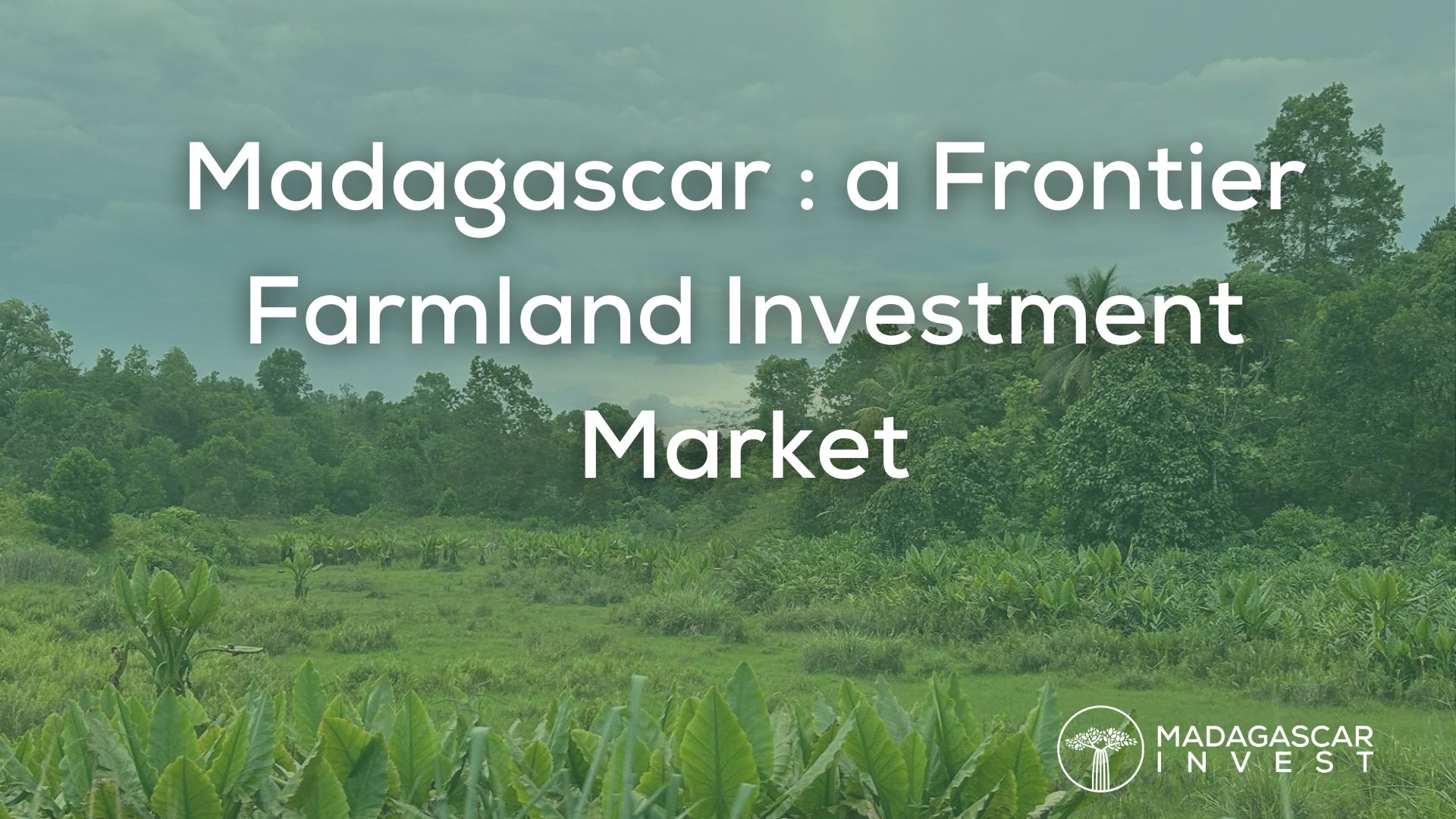
Madagascar’s diverse climate and geography provide strong foundations for agricultural production, supporting a wide range of crops across the island.
With abundant underutilized land, favorable growing conditions, and low entry prices, the country offers an increasingly rare opportunity compared to more mature agricultural markets.
This article examines why farmland investment in Madagascar is attracting growing interest and positioning the country as a promising destination for investors in Africa and the Indian Ocean region.
Tl; dr: Madagascar is emerging as a compelling destination for farmland investment, combining low entry prices with strong long‑term growth drivers. Growing food demand is driving farmland investment, made accessible through structures like Madagascar Farmland Trust.
Madagascar Structural Growth: Riding Powerful Demographic and Food Demand Trends
The starting point for understanding Madagascar farmland as an investment is growth. Madagascar is an emerging market with a highly favorable demographic profile: a young, expanding population combined with rising urbanization is driving steadily increasing demand for food and agricultural products over the coming decades.
In such an environment, productive farmland is not merely real estate; it is a core production asset. As food demand grows, demand for quality agricultural land rises alongside it, placing upward pressure on both land values and farm output prices.
For investors with a 10-, 20-, or 30-year horizon, this creates the potential for substantial capital appreciation as farmland is gradually repriced to reflect its growing strategic importance.
Madagascar is still at an early stage of this revaluation. Land remains comparatively affordable and underutilized as around 70% is classified as agricultural land although only a small fraction, around 5-10%, is actually cultivated.
Yet the macro forces that historically drive farmland values (population growth, food demand, and increasing global interest in agricultural assets) are already clearly in motion.
Investors who position themselves early in such a market seek to benefit from the full compounding effect: low initial entry costs, improving productivity, and rising demand all working together over time.
Global Scarcity: Why Titled Farmland Is Becoming a Strategic Asset
Globally, titled, investable farmland is becoming increasingly scarce. In many developed markets, agricultural land has already been consolidated, tightly regulated, or converted to non-agricultural use. As a result, prices have risen sharply, while incremental yield improvements have become harder to achieve.
This scarcity is pushing institutional and private investors to look toward emerging markets where land is still available, legally structured, and capable of productivity gains.
Madagascar offers a rare combination in this context: titled farmland at scale, available at prices far below global averages, with significant upside potential as infrastructure improves and professional management is applied.
As global competition for food-producing assets intensifies over the coming decade, such markets are likely to attract increasing attention and capital.
Diversification: Adding a Non‑Correlated Real Asset to Your Portfolio
Agricultural land is a low-correlation asset whose performance is driven more by food demand, local productivity, and long-term fundamentals than by daily financial market volatility.
People must eat regardless of the direction of stock indices, and this basic reality gives farmland a stabilizing role within a diversified portfolio.
Diversification is not about owning more assets, it is about owning assets that behave differently. Madagascar farmland adds a distinct return driver that is fundamentally disconnected from overheated equity markets or compressed bond yields in Western economies.
Historically, farmland has also acted as a natural hedge against inflation. As food prices, commodities, and production inputs rise, farmland values and crop revenues have tended to move in the same direction.
The logic is straightforward: when the food produced on land becomes more valuable in currency terms, the land that produces it follows. Rather than being eroded by inflation, investors hold an asset that has historically benefited from the same forces that weaken traditional financial instruments.
An investment in Madagascar Farmland Trust introduces exposure to:
- A real, physical asset in a frontier agricultural market
- Cash flows derived from food production rather than financial engineering
- A return profile not expected to mirror the cyclical swings of public markets
Sustainability and Impact: Investing in the Planet’s Future
An investment with Madagascar Farmland Trust is positioned as a contribution to the planet’s future as well as to your portfolio. The projects are designed to be eco‑friendly and sustainable, supporting practices that protect soil health, encourage biodiversity, and use resources more efficiently.
They also contribute to broader efforts in Madagascar such as reforestation and improving local food security, both critical issues on an island known for its unique environment and development challenges.
For investors, this means capital is put to work in a way that aims to generate measurable positive impact alongside financial returns.
You are not simply buying land for speculation; you are participating in building more sustainable agricultural systems and supporting long‑term resilience in a country where responsible investment can make a meaningful difference.
What Sets Madagascar Farmland Apart from Other Markets?
Many regions around the world offer farmland, but Madagascar stands out for a combination of factors that are increasingly rare in more mature markets.
Exceptionally affordable land prices
Madagascar still offers some of the most affordable agricultural land prices globally, giving investors a uniquely low entry point compared with many other regions. This affordability increases the potential for significant upside as the market develops and converges toward regional norms.
High potential for value appreciation
As an emerging market, Madagascar’s farmland has room for substantial land value growth over the medium to long term. As infrastructure improves, productivity rises, and both domestic and international demand deepen, quality farmland is likely to be repriced higher.
Climate suited to year‑round agriculture
The country’s climate is conducive to year‑round farming, which allows for multiple growing cycles and a diversity of crops. This reduces seasonality and can enhance the stability and resilience of farm revenues across different periods.
Ongoing annual dividend potential
A key attraction for income‑focused investors is the potential for regular annual dividend payouts from farm operations. Rather than waiting solely for capital gains, investors can aim to receive cash flow while holding the asset for long‑term appreciation.
Expert local management
Successful agriculture in any frontier market depends heavily on local expertise. Madagascar Farmland Trust is managed by Madagascar Invest and a team with deep knowledge of Malagasy agriculture, regulations, and investment processes. This helps to navigate operational complexity and manage risks on the ground.
Together, these elements position Madagascar not just as another farmland destination, but as a differentiated opportunity for investors who are willing to look beyond the most obvious, crowded markets.
Key Notes
- Titled farmland is scarce globally, making emerging markets increasingly attractive.
- Madagascar offers cheap land with high potential for value appreciation and productivity gains.
- Long-term food demand, driven by demographics and urbanization, supports farmland growth.
- Investing in farmland provides portfolio diversification away from volatile Western markets.
Conclusion
Across global markets, serious investors are increasingly reallocating capital from purely financial instruments into real, productive assets. Farmland sits at the center of this shift: it produces essential goods, benefits from long-term food demand, and has demonstrated resilience across economic cycles.
Madagascar is now emerging as one of the most compelling frontier farmland investment markets worldwide. With affordable entry prices, strong demographic tailwinds, and professional management structures such as Madagascar Farmland Trust, the country offers a rare opportunity to combine long-term growth, passive income, and positive impact within a single allocation.
If you are ready to explore farmland investing or real estate in Madagascar, or if you simply want to learn more, our team will be thrilled to hear from you, don’t hesitate to get in touch.